Rob built Jobbi for his own job search. Agents research roles and prepare materials. Its document workflow turns approved career evidence into a resume draft, with missing information visible before review.
He separated what a posting asks for from what the source material supports. The job interface shows selected evidence, unresolved questions, and draft generation together. That gives the reviewer concrete claims to inspect before using the document.
Jobbi loads a catalog of approved claims. Each claim points to its source and resume component. The loader rejects unapproved claims, blocked or unverified bullets, and active bullets missing from the catalog.
Jobbi recognizes requirements through a defined list of matching terms. Deterministic rules rank the relevant approved claims. A requirement can change which experience appears and its order. It cannot supply new experience.
A recognized requirement without supporting evidence becomes a question. The shared review queue groups the same missing capability across jobs, so Rob can review one shared question.
Rob still has to verify the answer and update the approved source himself. The queue does not add facts automatically. A missing claim means the catalog has no supporting evidence for that requirement. It does not establish that Rob lacks the experience.
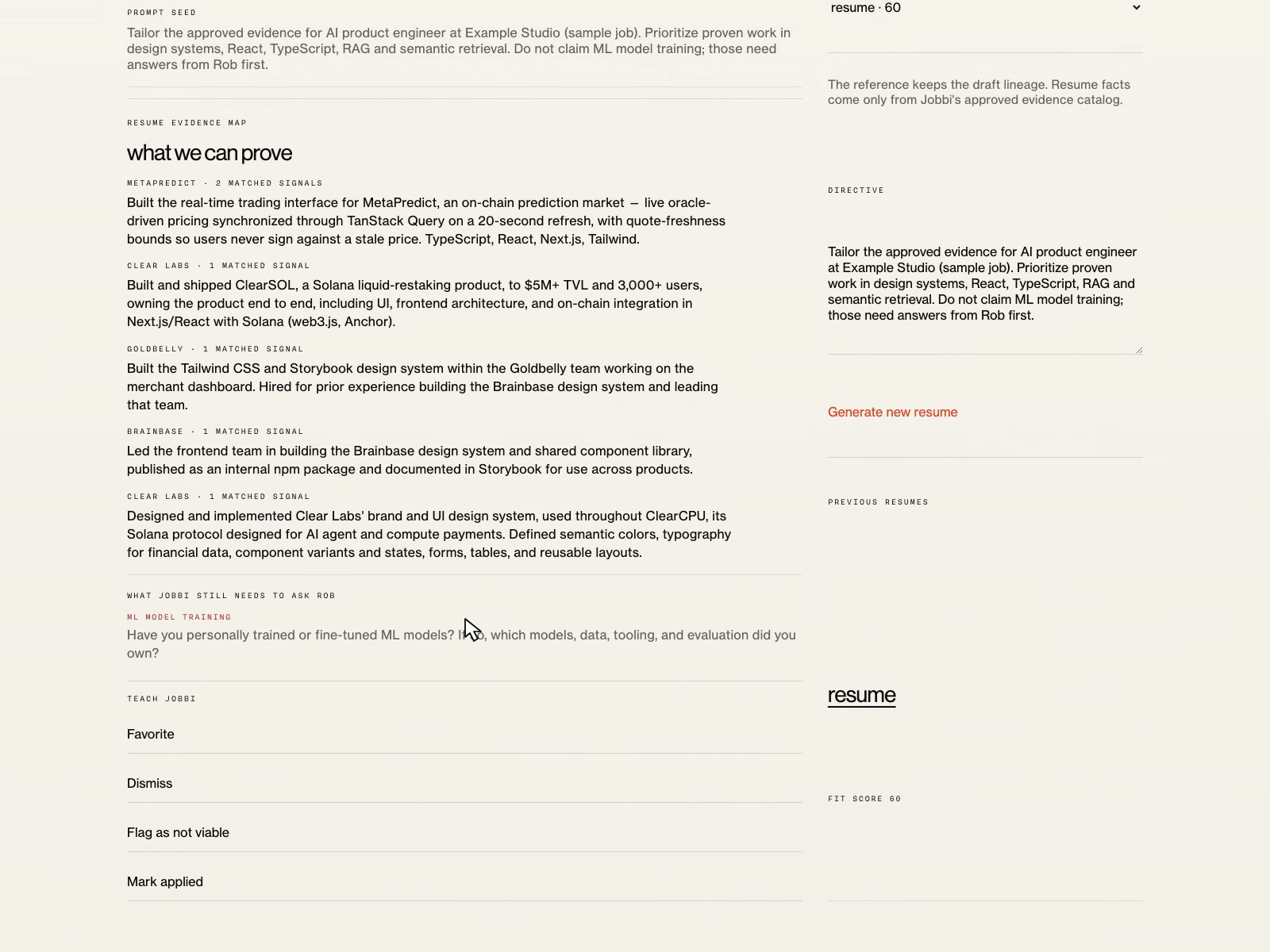
Each saved draft records selected claim IDs, recognized requirements, unresolved gaps, and fingerprints of the source catalog and job input. That makes the selection inspectable. It does not prove every source fact is true or that every requirement was recognized.
Draft generation stops when no approved claims match. Selection and assembly use deterministic rules within the broader agent workflow. The application link leaves the final application action to the user.
Jobbi is an internal tool, with no established callback improvement or measured time savings.
Dema, the design system behind this site